Supporters’ Month
The annual EU Gradsfund Supporters’ Month looked different this year. Where we normally encourage supporters to gather together to pray for the ministry of the EU and the EU Gradsfund, it was not possible to physically meet this year. Yet we were so encouraged by the amount of support shown by so many people throughout the month as we aimed to Pray, Give and Gather together as a partnership of students, staff and supporters. We prayed daily over the ministry on campus, reached our fundraising objective and gathered together online for prayer meetings and a webinar. We are so thankful for God’s faithfulness to us through so many financial and prayerful supporters.
One new initiative for Supporters’ Month was an online webinar – ‘Walking with Gen Z in Uncertain Times.’ We share a common goal with you – to enable our students to be ready to enter the next phase of their lives as mature servant hearted followers of Jesus. Here is a crash course on what was discussed on the night.
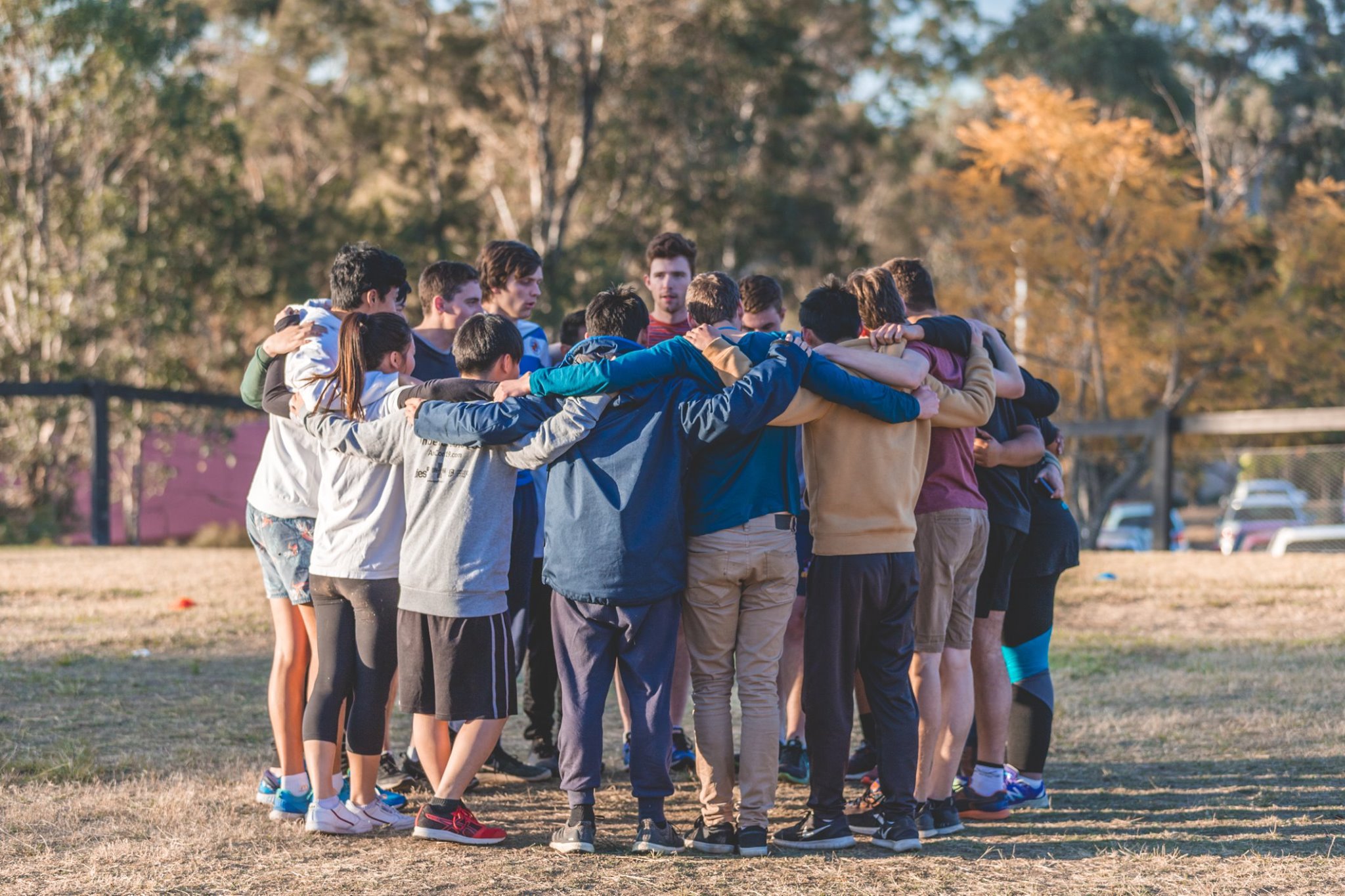
Generation Z are born between 1995 and 2009. These are the students we are working with every day, but you would be interacting with too – maybe your own children, or through your church.
Characteristics of Gen Z
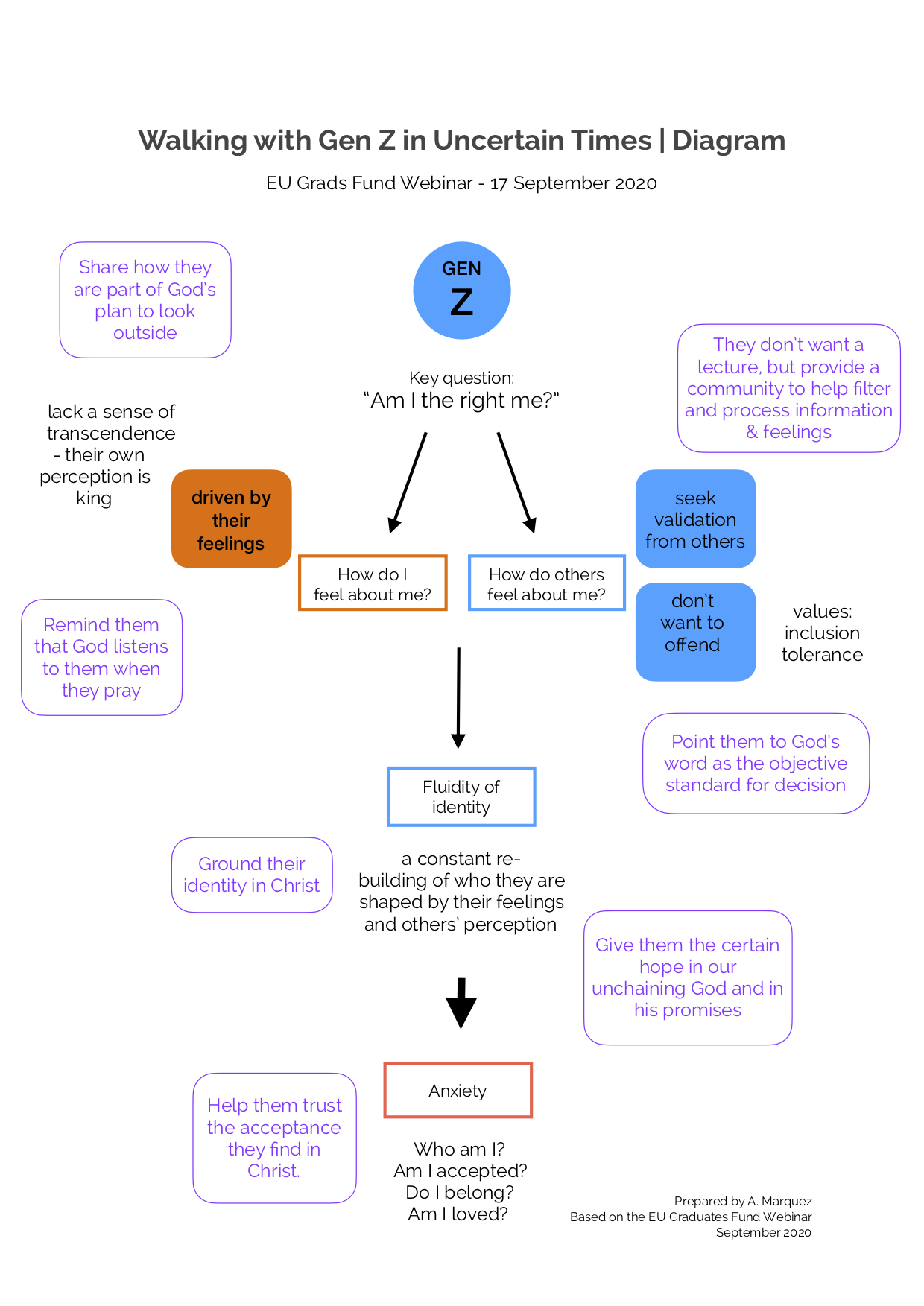
1. Driven by Feelings
They see the world as limited to their own sensory perceptions. For example, I recently had a conversation with a student who said, “I don’t know if I feel led to lead a bible study this year.” It is a deeply personal, yet very subjective way to make decisions.
We need to be continually pointing to the place of God’s word in their lives, giving them an objective reality as an external anchor to understand their feelings, especially when they are feeling confused, or not coping with the world.
2. Challenged in making choices in life
Students have been raised with nearly unlimited options to choose what they want to do, and have a significant attitude of fluidity – pick one thing, if it doesn’t feel right, then pick something else. They have to decide what influences they will listen to in making decisions.
We need to remind our students of the certainty, stability and trustworthiness of the Bible. This reality will significantly assist them in the choice that they make in life – especially while at uni.
3. People in charge aren’t listening (or solving the problem)
Gen Z, when feeling upset about something, presume older people don’t understand. ‘My feelings are uniquely mine, and no one else must have ever felt these things.’
For Christian students, we should remind them that God is in control, even if their experience suggests this isn’t the case. Similarly we need to keep helping our students remember that God not only exists and is sovereign, but also desires to hear their requests.
4. Activist generation (yet radically inclusivist)
Gen Z has a strong desire and expectation that things conform to how they think they should be. The worst thing one can be is intolerant, and to be heard, shout louder! This creates a significant challenge with regard to evangelism & conversion. We must remind students to be bold in proclaiming the Gospel and its offer of inclusion – only in Jesus.
5. Highly anxious in determining identity
Individualism and fluidity pushes traditional beliefs – seen in the multitude of different gender options available on Facebook, and the seeming ease with which individuals move between different expressions of their sexuality. For Christian students confronted with conversations around gender and sexuality, we need to remind them of the Bible’s understanding of gender and sexuality and the goodness of God in this area of life.
Gen Z are in the middle of a significant identity war – they are desperately seeking to work out who they are, and who they are meant to be. That they are driven by feelings means they think it easier to create new categories of identity. So they engage with others who have done similarly and end up with a different, yet unsatisfied, identity.
“Have I chosen the right identity?
Will my new found identity be acceptable to others?”
Because they are performance driven – ‘I am as I am seen to be’ – a feedback loop is created. ‘I build an identity, I perform it, in my fluidity I re-build it based on how I am feeling’, and because there is a wariness to confrontation and a strong desire for tolerance, Gen Z will keep seeking to ‘re-create’ themselves – finding a balance between who they feel they should be and who they perceive others want them to be. This causes significant anxiety for them.
Can you imagine anything worse? Going through life living like this. Never really being sure, never really knowing acceptance, never really belonging, never really being loved.
This manifests itself in some ways you might recognise:
– struggling to know how to make a choice
– feeling anxious or confused
– being frustrated trying to work out who they are.
Into this, the world in which students live in is filled with uncertainty. The world which they know and understand is being unravelled due to Covid.
Therefore, resilience is one key factor we need to help Gen Z develop.
Resilience is tied to four key things:
1. Community
Genuine relationships mutually encourage each other and provide comfort and joy. We need to help Gen Z find those who will walk with them, care for them, grieve with them, and share life together.
2. Hope & Certainty
When it feels like their world is being turned upside down, Gen Z need anchoring in the eternal truth of the gospel. We should never tire of reminding them that in Jesus’ death and resurrection they are God’s adopted children, and that their sure and certain hope is in heaven being kept for them. We need to help them see they are included in God’s eternal plan for the world.
3. Adaptation
We have to teach students that the opportunity to make changes and adapt to different situations can build resilience. There is no “best” choice in life, and hence if they don’t make the best choice they haven’t mucked up God’s plan. Instead, there are lots of good choices which they can make.
4. Context
They need a safe place to develop resilience, and navigate life’s big decisions. Hence what they need is loving friends, family, other members of the church and ministries like the Gradsfund as it supplies staff workers to the EU to help them as they try and move forward.
Watch the full video of the night here: